Climbing Mount Kinabalu: A Grounded Guide to Reaching Low’s Peak
Planning on climbing Mount Kinabalu? This complete guide breaks down the simple booking process, 2D1N and 3D2N packages, Via Ferrata routes, current official fees, packing essentials, and what standing on Low's Peak actually feels like.
THINGS TO DO
SabahBorneo.com
10 min read
Every mountain has its own character, but Mount Kinabalu feels less like a single peak and more like a massive, breathing world rising out of the Sabah jungle. Standing at 4,095 meters, its dark granite horns pierce the high clouds above the Crocker Range, dominating the skyline long before you reach the park gates.
For many travelers, the journey up this mountain is the centerpiece of an overland expedition across Malaysian Borneo. You might spend your first days resting by the sea at a waterfront or beachfront hotel in Kota Kinabalu, watching the sun dip into the South China Sea while your legs get ready for the gradient ahead. From the coast, the road climbs steadily through rural Dusun countryside, quiet village settlements, and winding mountain passes into the chill of Kundasang.
You do not have to climb all the way to Low’s Peak to feel the magic of Mount Kinabalu; staying closer to the forest floor reveals a peaceful side of the mountain that many summit hikers miss. You can easily spend your days wandering the shaded botanical paths, waking up in cozy mountain chalets, and taking in the crisp mountain air by reading through our guide on Kinabalu Park and Kundasang: Where the Mountain Holds the Cold, or exploring our detailed accommodation breakdown on Where to Wake Up Beneath the Peak: Kinabalu Park and Kundasang Stays.
However, if your eyes keep drifting back toward those high grey slabs, stepping onto the trail is an experience that stays with you long after the sore calves fade.


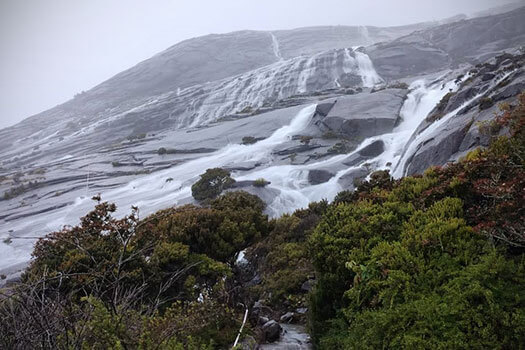
What makes climbing Mount Kinabalu so unique is not just its sheer height, but the incredible speed at which the surrounding landscape transforms around you. In a single morning, you walk through four distinct climate zones. You start in lush tropical lowland rainforests, pass through ancient montane oak and cloud forests draped in moss, emerge into sub-alpine thickets of flowering rhododendrons, and finally reach a stark, open world of bare granite worn smooth by ice and age.
It is also one of the most accessible high-altitude non-technical climbs in the world. You do not need ice axes, crampons, or ropes to reach the summit on a standard trek. All it takes is steady legs, mental endurance, and a willingness to wake up long before dawn to hike under a blanket of stars.
Along the trail, the mountain displays its legendary biodiversity. Kinabalu is home to thousands of plant species, including wild orchids, giant tree ferns, and carnivorous pitcher plants like Nepenthes villosa, whose delicate, ribbed urns cling to the damp mossy banks along the middle shelters.
Why This Climb Captivates Travelers
Nearly every climber tackles Mount Kinabalu on a structured itinerary centered around an overnight stay at the high-altitude base camp known as Panalaban, situated at 3,272 meters above sea level.
The Standard 2D1N Climb
This is the classic itinerary used by most hikers.
Day 1: You arrive at Kinabalu Park Headquarters early in the morning, complete registration, meet your assigned local mountain guide, and take a short shuttle to Timpohon Gate at 1,866 meters. From there, you climb 6 kilometers of continuous, stone-paved steps through the forest to reach Panalaban by mid-to-late afternoon. You eat an early dinner and turn in early.
Day 2: You wake up around 2:00 AM for a light supper before making the final 2.8-kilometer summit push under headlamp light. You reach Low’s Peak at 4,095 meters in time for sunrise, return to Panalaban for breakfast, and then begin the long, steep descent all the way back down to Timpohon Gate.
The 3D2N Itinerary
A 3D2N package adds an extra night at the base of the mountain before you climb, usually resting within Kinabalu Park HQ or in nearby Kundasang. This extra day is highly recommended if you are traveling from sea level. Spending a night at 1,500 to 1,800 meters gives your body time to adjust to the cooler air and higher elevation, drastically lowering your chances of experiencing early altitude sickness on Day 1.
Reserving an official Mount Kinabalu 2D1N or 3D2N climbing package in advance ensures your park permits, guide assignment, and base camp bed are all locked in before you arrive.


Understanding the Ascent: 2D1N vs. 3D2N Packages
For those looking for an extra adrenaline rush on the way down from the summit, Mount Kinabalu features the highest Via Ferrata ("iron road") in the world, managed by Mountain Torq.
Instead of walking straight back down the standard trail after sunrise, you strap into a harness, clip onto a fixed steel cable anchored into the granite face, and navigate narrow rock ledges, wire bridges, and drop-offs high above the cloud line.
There are two main Via Ferrata routes available:
Walk the Torq: A beginner-friendly, 2-hour route designed for anyone with basic fitness and no prior climbing experience. It provides a taste of height and exposure without being overly exhausting.
Low’s Peak Circuit: A longer, more demanding 4-to-5-hour route that includes a suspension bridge dangling over a massive gorge. It requires good physical stamina, as you must reach the summit and descend to the starting checkpoint by a strict cut-off time, usually around 6:30 AM at Sayat-Sayat.
If you choose a Via Ferrata package, your overnight stay at base camp will be at Pendant Hut, a cozy, alpine-style wooden lodge located just above the main Laban Rata Resthouse. Climbers joining Via Ferrata routes attend a mandatory safety briefing and harness fitting here at 4:00 PM on Day 1.
You can secure your spot on the cables by reserving a Mount Kinabalu Via Ferrata climbing package in advance, as daily permits for these routes are strictly capped.


Adding Via Ferrata: Walk Above the Clouds
Reaching the summit used to require navigating complex reservation systems, but the process has grown far simpler for modern travelers. Permits are capped at around 163 climbers per day to protect the delicate mountain environment and keep the trail from overcrowding. Because of this cap, permits sell out months in advance, particularly during the dry season.
The easiest way to book is through authorized operator packages that bundle all mandatory items into a single reservation: your park permit, climbing insurance, Panalaban hostel stay, all meals at base camp, and your mountain guide assignment.
Fees are regulated directly by state authorities. Under recent official updates from Sabah Parks, current rates stand at:
Climbing Permit: RM 100 for Malaysian adults, RM 50 for Malaysian children. RM 400 for International adults, RM 200 for International children.
Park Conservation Fee: RM 10 for Malaysian adults, RM 5 for Malaysian children. RM 50 for International adults, RM 25 for International children.
Mandatory Climbing Insurance: RM 10 per climber.
Compulsory Mountain Guide: RM 350 per guide, covering up to 5 adult climbers.
You can verify current official rates directly on the official Sabah Parks Mount Kinabalu fee page.


Official Booking Process and Recent Fee Updates
While many travelers historically used "Laban Rata" as a catch-all name for the entire base camp, Panalaban is the official name of the high-altitude plateau situated at 3,272 meters above sea level. Laban Rata is simply the central resthouse within a wider cluster of lodges managed across the ridge. Knowing the distinction helps avoid surprises, as your specific booking determines which lodge you check into for the night.
All accommodations sit within a few minutes' walk of one another along the exposed rock overlook:
Laban Rata Resthouse: The main hub of the plateau. It houses the central heated dining hall where all climbers gather for buffet-style meals (Day 1 dinner, Day 2 early supper, and Day 2 breakfast). Rooms consist of private twin rooms and unheated dormitory-style quarters with shared bathrooms.
Pendant Hut: Managed by Mountain Torq specifically for Via Ferrata climbers. Located just above Laban Rata, it offers clean, comfortable unisex dormitories, an alpine lounge stocked with climbing books, and a private dining space for breakfast.
Lemaing and Panalaban Hostels: Basic dormitory-style lodgings allocated for standard package bookings. While simple and unheated, they provide sturdy bunk beds, thick blankets, and cozy sleeping bags to keep you warm against the high-altitude chill.


Where You Stay at Base Camp: The Panalaban Plateau
The climb begins quietly at Timpohon Gate. You sign the park ledger, collect your plastic climber ID tag, and meet your mountain guide, a local Dusun mountaineer whose quiet confidence and steady pace will guide your steps over the next two days.
Day 1: The Step-by-Step Grind
The Timpohon Trail wastes no time playing around. It begins with a brief descent to Carson Falls before turning upward into a relentless series of oak, stone, and dirt steps.
Every kilometer or so, you encounter shelter huts like Layang-Layang, where you can sit on wooden benches, catch your breath, refuel on trail mix, and watch red mountain squirrels dodge around your boots.
As you cross 2,500 meters, the thick jungle canopy falls away, replaced by twisted rhododendron trees, lichen-draped branches, and cool mist drifting through the valley below. Your legs will grow heavy, your lungs will work harder in the thinning air, and by the time the metallic roofs of Panalaban appear through the clouds, reaching base camp feels like a major victory.
Day 2: The Night Ascent over Bare Granite
At 2:00 AM, the camp comes alive in the dark. Climbers quietly lace up boots, sip hot tea in the dining hall, and adjust their headlamps.
Stepping outside into the freezing night air is a shock to the system. You climb a series of steep wooden staircases in the dark before stepping directly onto the massive, exposed granite dome of the mountain. Here, thick white ropes are pegged into the rock face to guide your path. You grip the rope with gloved hands, pulling yourself up gentle slopes and steep rock pitches, following a long, snaking line of headlamp lights stretching into the darkness above.
You pass Sayat-Sayat at 3,668 meters, the final ranger checkpoint, where your permit tag is verified one last time. Beyond Sayat-Sayat, the vegetation disappears entirely. You are walking on smooth, dark rock under a massive sky.
When you reach Low’s Peak at 4,095 meters just as the horizon turns from deep purple to fiery orange, the sheer expanse of Borneo opens up beneath you. Cloud banks float thousands of feet below, casting shadows across the distant valley floors, while the jagged silhouette of St. John's Peak and South Peak stand dark against the dawn. Standing on that narrow rock outcrop, freezing cold and wind-blown, you feel tiny beside the mountain.
The Knee-Killing Descent
What many climbers underestimate is the descent. Reaching the summit is only half the journey.
After returning to Panalaban for a warm breakfast, you pack your bags and begin the 6-kilometer downward trek to Timpohon Gate. Lowering your body weight down thousands of uneven stone steps for four to five continuous hours tests your knees and thigh muscles far more than the climb up. Taking slow, deliberate steps and relying on trekking poles helps absorb the impact until you finally hear the voices of arriving hikers at the gate below.


The Human Reality of the Trail
Packing light is essential, as every extra kilogram on your back feels twice as heavy past 3,000 meters. If you prefer not to carry your gear, local porters can be hired at Timpohon Gate to carry your bag up to Panalaban for a set fee per kilogram.
What to Carry in Your Daypack
Headlamp: Essential with extra batteries for the 2:00 AM summit push.
Trekking Poles: Highly recommended to save your knees on the steep descent.
Warm Layering: Thermal base layer, fleece jacket, and a lightweight down coat for base camp and the summit, where temperatures drop near freezing (0°C to 5°C).
Waterproof Outer Shell: A quality rain jacket and rain pants. Rainstorms on Mount Kinabalu can roll in quickly with little warning.
Gloves and Beanie: Waterproof or thick wind-resistant gloves are essential. Holding onto frozen guide ropes with bare hands at 3:50 AM is painful.
Footwear: Well-broken-in hiking shoes or boots with good tread grip for slick granite.
Snacks and Hydration: Energy gels, chocolate, nuts, and a refillable 1.5-liter water bottle.
Weather Warnings and Safety Realities
Mount Kinabalu has its own weather system. Rain can fall at any time of year, turning soil trails into muddy creeks and rock faces into slick slides.
The most critical safety rule involves the summit closure policy. If heavy rain or thick mist rolls in during the early morning hours, park rangers will close the gates at Sayat-Sayat Checkpoint for safety reasons. If the summit section is closed due to high winds or slippery conditions, climbers must turn back at Sayat-Sayat. Accept this reality with grace: the mountain will always be there, and your safety is what matters most.


Essential Packing List and Ground Warnings
Mount Kinabalu can be climbed year-round, but weather patterns dictate how dry your trek will be:
March to September (Preferred Dry Season): Clearer skies, lower rainfall, and better chances of uninterrupted sunrise views from Low's Peak. March and April are often considered the prime weather months.
October to February (Wet Season): Higher chance of afternoon downpours and morning mist. Climbs still run daily, but rain gear becomes your most critical piece of equipment.


Best Season to Climb
Once you walk out through Timpohon Gate, collect your colorful climber certificate at Park HQ, and let your legs rest, the rest of Sabah awaits.
Many travelers use the mountain climb as a pivot point between the west coast and the wild east coast. From Kinabalu Park, you can travel east overland toward the lowland jungles of Sandakan and Sepilok to see orangutans and sun bears, before drifting down the quiet waters of the Kinabatangan River in search of pygmy elephants and proboscis monkeys.
If you want to end your trip in deep, untouched primary rainforest, heading further south into Danum Valley offers a peaceful immersion under ancient canopy trees. And if you are keen to trade mountain granite for world-class underwater drop-offs, heading toward the turquoise reefs around Sipadan, Kapalai, and Mabul provides the ultimate coastal recovery after a hard summit trek.
Climbing Mount Kinabalu is a physical test, but more than that, it gives you a rare chance to slow down, step away from daily life, and measure your progress by the simple cadence of your own breath and boots on the trail.
Note: This piece contains affiliate links. Booking through these links generates a small commission that supports this site, at zero extra cost to the traveler.


Extending Your Borneo Journey Beyond the Mountain
Connect
Copyright © 2026 SabahBorneo.com - All Rights Reserved.
SabahBorneo.com
A journey through Sabah, Malaysian Borneo, is best experienced when you drop the rush and let each region reveal itself. SabahBorneo.com exists to share grounded observations, hand-picked quiet stays and local routes that respect both your time and travel investment, helping you strip away the logistics noise and settle into the natural rhythm of the island.