Kinabalu Park and Kundasang: Where the Mountain Holds the Cold
A leisurely guide to Kinabalu Park and Kundasang. Experience cold mountain air, oak forest trails, local markets, and quiet highland stays beneath the granite peak.
PLACES TO STAY
SabahBorneo.com
10 min read
The road climbing away when driving up from Kota Kinabalu does not hint at the cold until you pass through the park gates. The air shifts suddenly, turning from heavy sea humidity into a damp, woodsy chill that smells of moss, wet earth, and cedar.
Kinabalu Park rests in the mountain’s knees. Most travelers see it merely as a staging ground, a place to grab a wooden walking stick, strap on boots, and check a summit off a bucket list. But if you give the highland two nights without the urge to rush up the granite, the forest reveals a completely different rhythm.
Mornings here belong to the early light. Long before the day-buses wind up from the coast, the clouds roll back from the jagged peaks, exposing the raw, grey face of Mount Kinabalu rising sharply above the tree line. Sitting on a wooden deck with a hot cup of coffee as the mist clears over the valley is reason enough to make the journey.


*The main entrance gate into Kinabalu Park
The lower slopes of Kinabalu Park are defined by wet, ancient trees and cool mountain shade. This UNESCO World Heritage site is an isolated biological island. Because the mountain rises so steeply from the coastal plains to over 4,000 meters, it creates distinct ecological zones stacked directly on top of one another.
Down in the lower forest trails, like the Silau-Silau or Mempening paths, the ground underfoot is soft with decaying leaves and fallen oak acorns. Sunlight struggles to pierce the canopy, coming through in pale, broken shafts. Up here, tropical palms give way to ancient chestnuts, wild laurels, and mosses that wrap every trunk like thick green velvet.
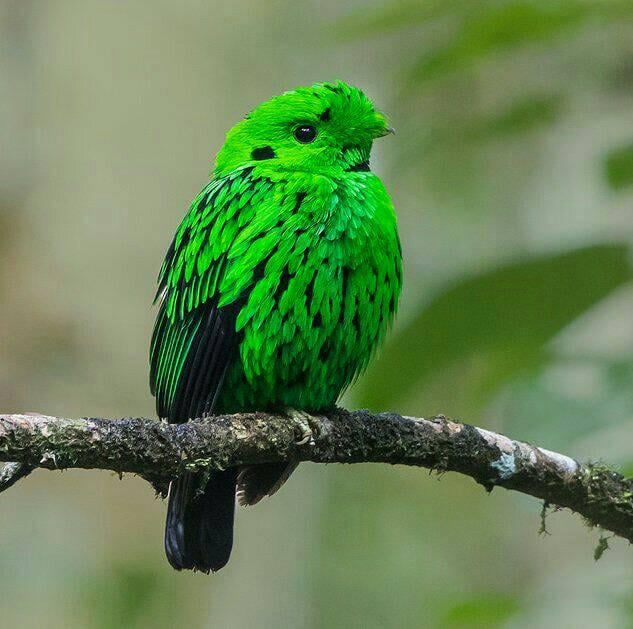
For birdwatchers and naturalists, this elevation is sacred ground. The early morning hours, right when the mist begins to lift, bring out species found nowhere else on earth. If you stand quietly along the trail, you might catch the metallic shimmer of a Bornean Treepie, the sharp call of a Mountain Serpent-Eagle circling the upper ridge, or the brief movement of a Crimson-headed Partridge picking through the damp leaf litter.
Botanists spend lifetimes here searching for rare endemic orchids, pitcher plants, and the elusive Rafflesia. While the giant blooms are occasionally spotted in the surrounding foothill villages near Poring, the park itself holds thousands of plant species that quietly thrive in the mountain’s microclimates.
Near the park headquarters, the air carries a subtle, focused energy around mid-morning. This is where climbers gather at Timpohon Gate to organize permits, adjust pack straps, and meet their local guides. Watching them set off onto the trail is a reminder of the summit's presence, but you do not need to carry a heavy pack up the rock to feel the weight of this mountain. Walking two miles into the quiet oak forest provides the same grounding sense of scale.

The Oak Forest and Lower Trails
*A beautiful Whitehead's Broadbill at Kinabalu Park
Reaching these highlands from the coast requires a two-hour drive that twists upward through Tamparuli and the mountain foothills. Halfway up, where the road narrows along the ridge, Pekan Nabalu offers a natural place to pull over and let the engine cool.
Nabalu is a small roadside trading post built around an open wooden lookout tower. On clear mornings, the view across the valley toward Mount Kinabalu is unobstructed. Local Dusun vendors sit behind long wooden tables stacked with fresh harvests, including sweet highland pineapples, small hill-bananas, bundles of wild ginger, and hand-woven rattan baskets. It is an unhurried stop where you can stretch your legs, buy a hand-carved walking stick, and watch the clouds begin their daily drift across the valley floor.
Further down the road, past the main park gates, the landscape opens up dramatically into Kundasang.
Kundasang is the agricultural heart of the highlands. Terraced cabbage and spring onion farms cling to steep, emerald-green hillsides that look almost impossibly sheer to cultivate. The air here carries a crisp, farm-cool edge in the early hours, mixed with the smell of wet soil and fresh produce.
At the center of town, the daily Kundasang market operates as a bustling line of open stalls along the main road. Farmers pull up in dusty pickup trucks to unload crates of highland vegetables, fresh strawberries, wild orchids, and stems of red durian.
By midday, however, the highland air catches you off guard. As the morning cloud cover burns off, Kundasang town can become surprisingly hot under the direct glare of the mid-afternoon sun. The tarmac holds the heat, and the open market stalls offer little breeze until the clouds begin to gather again around three or four in the afternoon.
Timing matters here. Visiting the stalls in the early morning or late afternoon lets you buy a bag of crisp cucumbers or local fruit straight from the growers in relative comfort, chatting with stallholders before the heat settles in or after the cool mountain air begins to return.
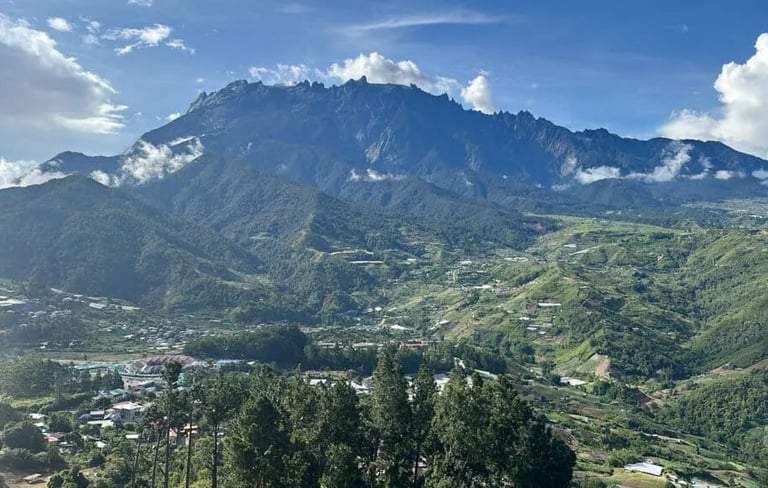
Pausing at the Gateways: Nabalu and Kundasang
Beyond the vegetable stalls, Kundasang holds quiet pockets of history and rural life that deserve a slower afternoon.
Standing on a quiet hill right above the town center is the Kundasang War Memorial. Built in 1962, it honors the British and Australian prisoners of war who perished during the brutal Sandakan Death Marches in World War II, as well as the local Dusun villagers who risked their lives to assist them.
The memorial is laid out across four interconnected gardens, moving from the native flora of the Borneo Garden to the manicured borders of the English Rose Garden and the quiet reflection pool at the top. It is a sombre, beautiful place. Standing on the stone terrace looking out over the valley while reading the names carved into bronze plates brings a heavy, grounding perspective to these peaceful hills.
Further east toward the valley floor at Mesilau, the terrain turns into wide grassy pastures. This is home to Desa Dairy Farm, a 199-hectare cattle ranch spread across the high plateau. The sight of black-and-white Holstein Friesian cows grazing on green slopes against the massive grey wall of Mount Kinabalu has earned the area a local nickname, but the atmosphere remains uniquely Sabahan.
The wind off the Mesilau plateau is cold and clean. Visitors gather near the barn to try fresh milk gelato or cold yogurt drinks, while young calves call out from the wooden pens. It is popular, and on weekends the narrow access road gets congested, but visiting early in the morning when the peak is clear of clouds yields a striking view of rural highland life.


*Desa Dairy Farm Kundasang, in the cool highlands of Mesilau
Life in the Valley Floors
If you follow the road further down the eastern slopes toward Ranau, the elevation drops and the cool mountain chill gives way to warm, lowland rainforest air.
Poring Hot Spring rests in this lower zone, named after the native poring bamboo that grows thick along the riverbanks. The main draw here is the natural sulfurous hot water, channeled into tiled outdoor tubs where travelers soak tired muscles after days spent walking the mountain trails.
Beyond the hot tubs, a wooden boardwalk leads deep into the dipterocarp forest toward the Poring Canopy Walkway. Suspended 41 meters above the forest floor, these narrow rope-and-plank bridges sway gently between massive primary trees. Walking across gives a bird’s-eye view of giant ferns, wild lianas, and the dense understory below. Nearby, short trails lead to Kipungit Waterfall and dark limestone caves where bats roost in the cool rock gaps.
For those interested in how local communities manage their natural resources, the nearby rivers offer a glimpse into a traditional conservation practice known as Tagal.
At Fish Spa Tagal in Kampung Luanti and Kampung Marakau near Ranau, the local Dusun villagers enforce strict seasonal fishing bans to protect the river ecosystems. Because the fish are never harvested or harmed in these designated zones, hundreds of native pelian (river carp) gather in the clear, cold water without fear.
Visitors can step directly into the shallow riverbed, where the fish swarm gently around submerged feet to nibble away dead skin. The water is freezing, the nibbling causes an unavoidable laugh, and the surrounding jungle canopy keeps the riverbank shaded and calm. It is a simple, clever system that turns traditional conservation into a living experience.


*Fish Spa Tagal at Kampung Luanti, Ranau
Stepping Out to the Edges: Poring and the River Spas
For those who want to feel the mountain under their boots without committing to a full summit climb, two hills near Kundasang offer rewarding views of the high country at very different paces.
Right behind Kundasang town, Sosodikon Hill is a gentle, 15-minute walk up an open grassy ridge. The path is soft underfoot and simple enough for travelers of almost any age. Standing at the top early in the morning yields an unobstructed 360-degree view across the entire valley floor, watching the morning light hit the terraced cabbage fields and the distant mountain ridge.
Further up in the quiet village of Mesilau, Maragang Hill offers a more substantial forest trek. Reaching an elevation of 2,232 meters, this community-managed trail winds through a dense, damp mossy forest filled with native orchids and wild pitcher plants. The 4-hour return hike requires a local Dusun community guide, who leads you along narrow ridge lines up to an open platform. Reaching the summit rewards you with an extraordinarily close, dramatic view of Mount Kinabalu’s eastern face, far removed from the busier tourist crowds down below.


Short Hikes and Highland Trails
Beyond the quiet nature trails, the open terrain stretching out toward the valley floor and down toward Lohan offers a different way to experience the high country. As the landscape widens into broader agricultural land, the foothills open up space for outdoor drives, aerial views, and family pauses.
For an entirely different perspective on the mountain's scale, tandem flights with Ranau Paragliding Park launch from the high grassy ridges at Lohan. Gliding on warm mountain thermals, you float silently hundreds of feet above the valley floor, looking down at sprawling tea plantations, winding riverbeds, and traditional Dusun villages set against the massive background of the Crocker Range. Because flights depend heavily on stable wind conditions, early morning offers the best window to take off before the afternoon clouds build up.
If you prefer keeping your wheels on the ground, ATV Borneo Adventure Kundasang operates guided four-wheel routes through the unpaved backroads around Mesilau. Riding these open vehicles takes you off the tarmac and onto the gravel farm tracks, navigating shallow muddy streams and winding past steep cabbage patches with the massive grey granite wall looming directly overhead whenever the trail breaks out of the trees.
Families traveling with younger children often find a pleasant change of pace along the Mesilau and Ranau foothill roads. A short drive into the cool hills near Mesilau leads to the Alpaca Club Kundasang, where a small herd of South American alpacas thrives in the chilly mountain air. Scheduled visit slots keep the environment calm, allowing visitors to step into the enclosures, touch their thick wool, and hand-feed them against the backdrop of the misty valley. Further down near Ranau, the Ranau Rabbit Farm offers a sloped, open-air garden filled with landscaped footpaths, wooden bridges, and open enclosures where kids can hold and feed dozens of rabbit breeds along the terraced hillside paths.


Foothill Adventures and Family Stops
Choosing where to stay in the highlands comes down to a simple trade-off: do you want to wake up inside the quiet, damp oak forest, or do you want to look at the mountain from an open balcony across the valley?
Staying Inside the Park Boundary
If your priority is nature, peace, and immediate access to the forest trails, staying inside the national park grounds is unbeatable.
Sutera Sanctuary Lodges (Kinabalu Park):
Sutera manages all the accommodation options located directly within the park boundaries. These range from private timber cabins like the Peak Lodge and Nepenthes Lodge to individual rooms at the Hill Lodge.
The experience of staying here is atmospheric. The wooden cabins sit directly beneath the high tree canopy. At night, the temperature drops sharply, and the silence is broken only by the sound of wind through the branches and forest crickets. You can step directly out of your front door onto the forest paths before the gates open to day visitors.
Trade-off: Booking requires planning well in advance, and dining options are limited to the two restaurants inside the park grounds, which carry higher western-resort prices.
Staying Outside in the Valley
If you prefer wide views of the peak, easier access to local roadside eateries, and proven reliability, two long-standing establishments outside the gate stand out.
Positioned on a hillside just off the main road in Kundasang, Kinabalu Pine Resort is one of the oldest and most reliable stays in the region. The resort consists of wooden cabin blocks built along terraced grounds, with every room facing directly toward Mount Kinabalu.
Waking up here means stepping out onto a wooden balcony at 6:00 AM to watch the morning light hit the granite peaks while the valley below remains blanketed in mist. The grounds are lined with native pine trees, the onsite restaurant serves warm local stir-fries, and the location puts you minutes from the Kundasang vegetable market.
Perkasa Hotel sits high on a prominent ridge overlooking Kundasang town. It is a traditional highland hotel that has survived decades in business, offering a nostalgic, unpretentious place to rest.
While the building and furnishings reflect its age, its elevated position provides one of the most commanding panoramic views in the entire region. From the wide wooden balconies and the dining room, you look straight across the valley to the full expanse of the mountain wall. It is comfortable, quiet, and places you right in the center of the highland landscape.

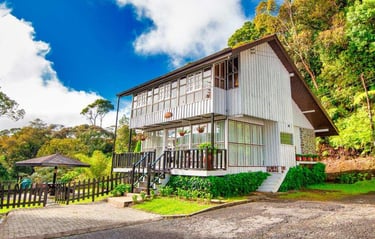
*Sutera Sanctuary Lodges, Kinabalu Park
Where to Stay: Park Boundaries and Valley Resorts
Highland travel in Sabah requires a shift in mindset. The roads are steep, the weather changes quickly, and afternoon rain showers routinely blanket the valleys in thick white fog by 2:00 PM.
Instead of trying to squeeze Poring Hot Springs, the dairy farm, the war memorial, and three different viewpoints into a single day, let the weather dictate your schedule. Spend your mornings outdoors when the mountain peak is clear and the air is crisp. When the afternoon mist rolls in and the rain begins to patter against the tin roofs, retreat to a wooden veranda with a hot drink and let the mountain hold its cold.
For most, watching the peak emerge through the morning mist from a valley porch is enough. But for those who feel the pull to step onto the granite itself, the journey continues past the lower trails, carrying you up through Timpohon Gate and toward the summit rock of Low’s Peak.
Note: This piece contains affiliate links. Booking through these links generates a small commission that supports this site, at zero extra cost to the traveler.


Setting a Patient Pace
Connect
Copyright © 2026 SabahBorneo.com - All Rights Reserved.
SabahBorneo.com
A journey through Sabah, Malaysian Borneo, is best experienced when you drop the rush and let each region reveal itself. SabahBorneo.com exists to share grounded observations, hand-picked quiet stays and local routes that respect both your time and travel investment, helping you strip away the logistics noise and settle into the natural rhythm of the island.